From Prototype Key to Workflow Optimization
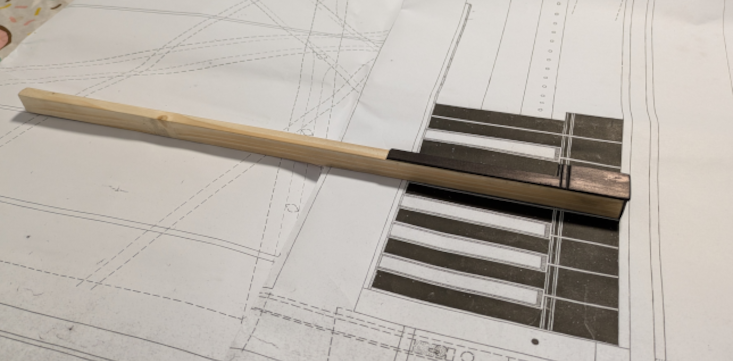
Today was spent crafting a single test key for the action model. Alongside the physical piece, my goal was to establish and test an efficient, repeatable workflow for making the keys entirely by hand.
While the key itself was completed today and the result is reasonably nice, it doesn't quite meet my final standards yet. I will end up remaking this particular key. The greatest takeaway from today was about the process itself: the workflow still needs refinement and requires the creation of specific custom jigs to ensure the work proceeds more fluidly and with absolute precision.
For the production of the entire keyboard, I am planning to use the traditional method: preparing one wide, solid plank first. This ensures that the height of all the keys is perfectly uniform from the start. From this single blank, the individual keys will then be sawn and separated for final shaping and fine-tuning, leaving, of course, proper allowances for planing.
Building a historical piano truly demands a vast amount of time dedicated just to making specialized jigs, templates, and auxiliary tools. Without them, meeting strict quality criteria and achieving true historical authenticity simply wouldn't be possible. So, before the actual keyboard underway, it’s time for some tool-making.
While the key itself was completed today and the result is reasonably nice, it doesn't quite meet my final standards yet. I will end up remaking this particular key. The greatest takeaway from today was about the process itself: the workflow still needs refinement and requires the creation of specific custom jigs to ensure the work proceeds more fluidly and with absolute precision.
For the production of the entire keyboard, I am planning to use the traditional method: preparing one wide, solid plank first. This ensures that the height of all the keys is perfectly uniform from the start. From this single blank, the individual keys will then be sawn and separated for final shaping and fine-tuning, leaving, of course, proper allowances for planing.
Building a historical piano truly demands a vast amount of time dedicated just to making specialized jigs, templates, and auxiliary tools. Without them, meeting strict quality criteria and achieving true historical authenticity simply wouldn't be possible. So, before the actual keyboard underway, it’s time for some tool-making.